
Hi there! TechResolveHub — a place where technology meets simplicity.
If you’re an aspiring developer, embedded engineer, or someone curious about how Linux, C++, or DevOps work in real-world applications, you’re in the right place.
What You’ll Find Here
Practical Guides on Linux commands, C++, DevOps, and embedded systems
Step-by-step Tutorials to help you set up tools, solve technical issues, and automate workflows
Tips & Insights for developers at all levels — especially beginners trying to break into the tech world
Popular Posts
- Unveiling the Power of SSH in Linux: Secure Remote Access and Embedded Hardware Platforms
- 5 Must-Know Linux Commands for Embedded Developers
- Top Mistakes to Avoid in Embedded Linux Development
- A Beginner’s Guide: Adding a User to sudoers in any Linux System
Thanks for stopping by — now let’s resolve tech, one byte at a time!
Agile Isn’t Just for Software — It’s for Life
When we hear Agile, most of us think of software development, Scrum boards, and sprint planning meetings. But Agile is more than just a work methodology — it’s a mindset. The same principles that help teams deliver software effectively can also guide us in building better, more balanced lives.
Here’s how the Agile mindset applies outside the workplace:
1. Sprints: Break Big Goals into Small Steps
In software, work is divided into short, manageable sprints. The same approach works beautifully in life.
- Instead of setting overwhelming yearly goals, focus on 1–2 week mini-goals.
- Want to get healthier? Start with a 2-week sprint of daily walks instead of planning a perfect diet and workout plan all at once.
- Want to learn a new skill? Break it into “sprints” like Week 1: Setup tools, Week 2: Basics, Week 3: Projects.
Small, consistent wins add up to big progress.
2. Retrospectives: Reflect, Don’t Judge
After every sprint, Agile teams hold a retrospective to discuss what worked, what didn’t, and what can be improved.
In life, this means pausing regularly to check in with yourself:
- What did I do well this week?
- What drained my energy?
- What can I try differently next week?
This turns failures into feedback and keeps you moving forward without guilt.
3. Adaptability: Embrace Change Gracefully
Agile thrives in uncertain environments where requirements change. Life is no different — plans rarely go exactly as expected.
- Job changes, family needs, or unexpected challenges don’t have to derail us.
- Instead of resisting, adjust your sprint goals and keep moving.
- The key is focusing on what’s within your control and iterating as life unfolds.
Adaptability makes you resilient and future-ready.
4. Continuous Improvement: Growth Over Perfection
Agile emphasizes delivering value early and improving continuously. Perfection is not the goal — progress is.
In personal life, this means:
- Don’t wait for the “perfect” time to start.
- Begin small, learn as you go, and refine along the way.
Life is not about one big release — it’s about constant updates and improvements.
Visual diagram of an “Agile for Life – Personal Sprint Board”
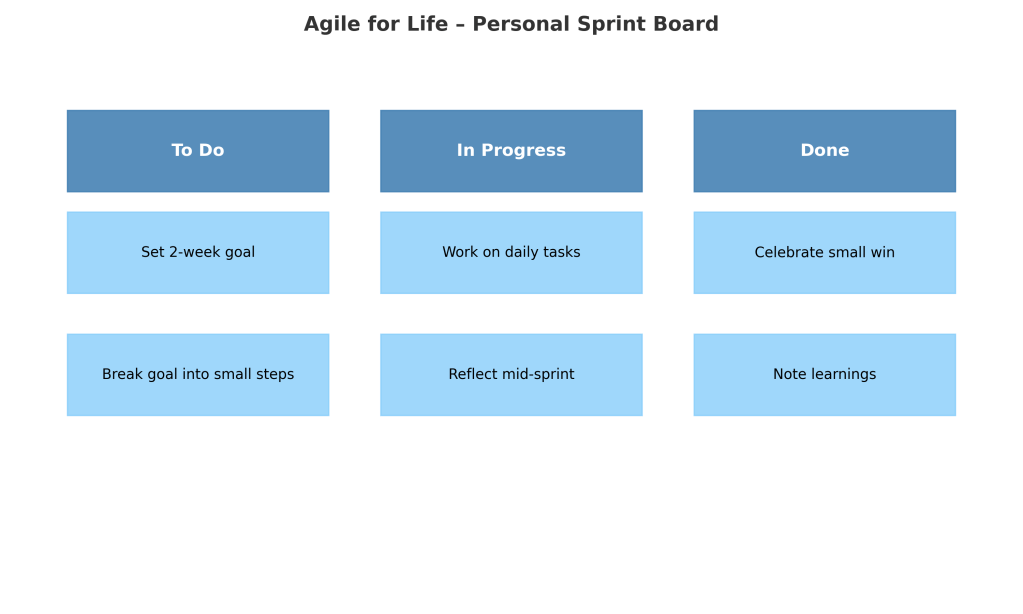
It shows how personal goals can be tracked just like Agile tasks:
- To Do: Set a 2-week goal, break it into steps
- In Progress: Daily tasks, mid-sprint reflection
- Done: Celebrate small wins, note learnings
Key Takeaway
Agile teaches us that progress is more valuable than perfection, learning matters more than failing, and flexibility is stronger than rigidity.
So next time you’re setting goals or facing challenges, try asking yourself:
“How would I handle this if I were running life like an Agile sprint?”
Remember: Live Agile, not just work Agile.
Top Mistakes to Avoid in Embedded Linux Development
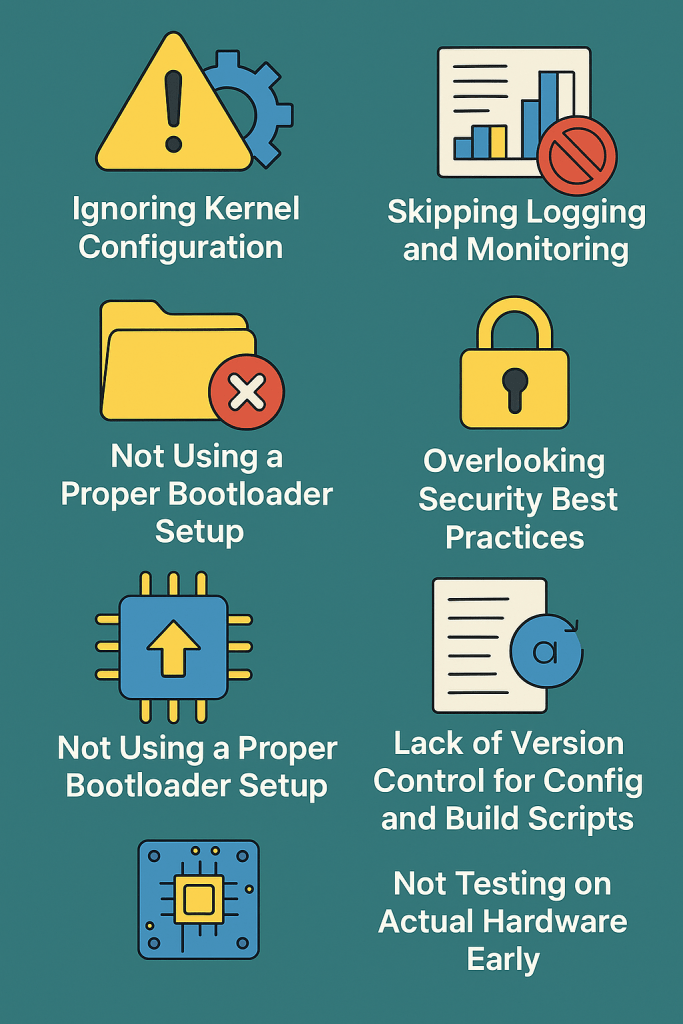
Embedded Linux offers a powerful and flexible platform for building custom devices — from routers and industrial controllers to smart home appliances. But working in this space comes with unique challenges that aren’t always obvious to newcomers.
If you’re getting started with Embedded Linux development, here are some common (but avoidable) mistakes that could cost you time, performance, or even product stability.
1. Ignoring Kernel Configuration
Many developers use default kernel configurations without customizing it for their hardware.
Mistake:
- Leaving unnecessary drivers or debug options enabled.
- Missing critical hardware support for your board (e.g., SPI, I2C, GPIO).
Fix:
- Use
make menuconfig(orxconfig) to tailor the kernel. - Disable what you don’t need — it reduces size and boot time.
2. Bloated Root Filesystem
It’s tempting to include everything in the root filesystem during development.
Mistake:
- Shipping the same bloated image to production.
- Keeping tools like
gcc,gdb, or evennanoin the final image.
Fix:
- Use tools like Buildroot or Yocto to create minimal production images.
- Separate your debug image and production image builds.
3. Not Using a Proper Bootloader Setup
The bootloader (usually U-Boot) is critical in embedded systems.
Mistake:
- Ignoring U-Boot configuration.
- Not backing up working bootloader settings.
Fix:
- Learn the basics of U-Boot commands and environment variables.
- Save a backup of known-good U-Boot config (
printenv,saveenv).
4. Skipping Logging and Monitoring
Without logs, debugging in Embedded Linux is like flying blind.
Mistake:
- Not enabling kernel logging (
dmesg). - Not using
syslogorlogread.
Fix:
- Configure lightweight loggers like BusyBox syslog or logrotate.
- For advanced use: forward logs over UART or remote via
netconsole.
5. Overlooking Security Best Practices
Security is often an afterthought — but embedded devices are always connected these days.
Mistake:
- Using default root passwords.
- Leaving services like SSH open to all interfaces.
Fix:
- Disable unused services.
- Use read-only filesystems and non-root users for applications.
- Regularly update busybox/uClibc/libc and other core packages.
4. Lack of Version Control for Config and Build Scripts
You might be using Git for source code, but what about your build scripts, kernel configs, and environment setup?
Mistake:
- Manually modifying files without version tracking.
Fix:
- Keep your entire build system — including
.configfiles and device trees — under Git. - Document custom patches and build steps clearly.
7. Not Testing on Actual Hardware Early
Simulation or QEMU is good for prototyping, but it hides real-world problems.
Mistake:
- Developing purely on host or emulator.
- Postponing hardware testing until late.
Fix:
- Flash and test often on real hardware.
- Watch out for hardware timing issues, I/O race conditions, or thermal problems.
Final Thoughts
Embedded Linux gives you immense control, but also demands discipline. Avoiding these common mistakes can help you build stable, secure, and maintainable systems.
Take time to set up your environment correctly, document as you go, and always test on real hardware.
If you’re working on your first project, bookmark this list — it might just save you days of debugging later!
 TechResolveHub